In today’s highly regulated life-science environment, GxP compliance is essential to ensure product quality, patient safety, and regulatory integrity. Whether you’re in pharmaceuticals, biotechnology, medical devices, clinical testing, or healthcare manufacturing, GxP defines how processes must be controlled, validated, and monitored.
Many professionals search terms like “What is GxP in pharma?” “GxP FDA requirements,” “GxP guidelines PDF,” and “What is GxP data?”—yet still struggle to fully understand how deeply GxP influences the operational ecosystem.
This article clarifies the framework, purpose, applications, and compliance expectations surrounding GxP.
GxP stands for Good x Practice, where “x” represents a specific regulated discipline.
Examples include
Each category ensures that products and processes consistently meet expectations for quality, traceability, and safety.
The primary purpose of GxP is to ensure that regulated products are safe, effective, and manufactured consistently under verified, controlled systems.
The framework exists to:
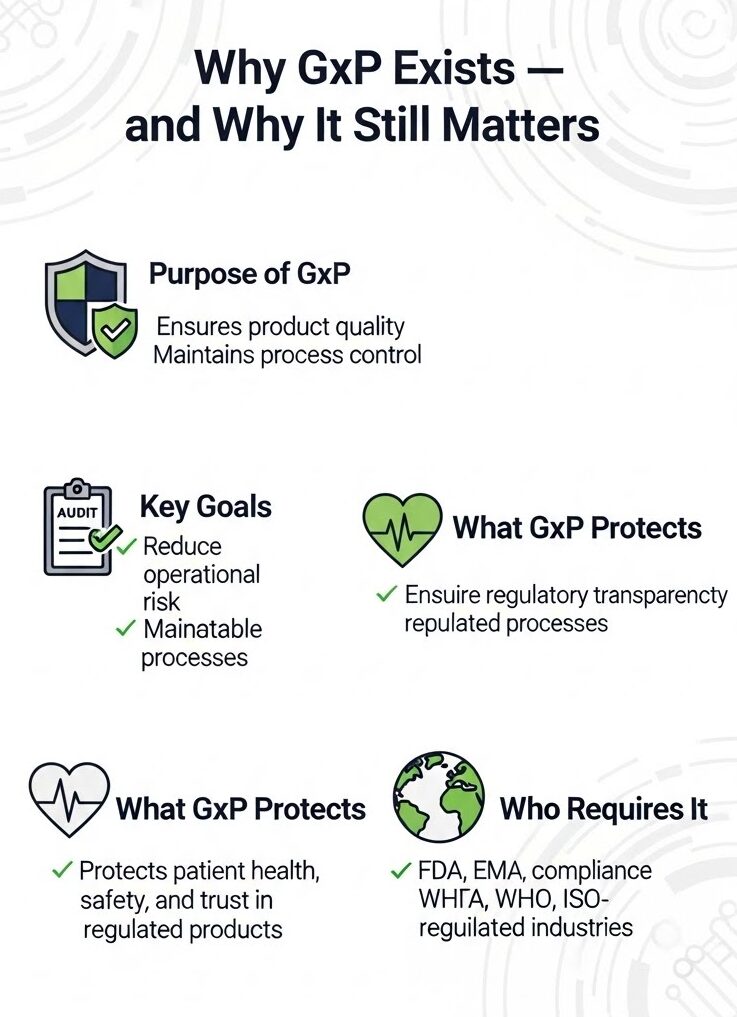
Regulatory bodies like the U.S. FDA, EU EMA, MHRA, and ICH enforce GxP compliance.
The FDA requires systems and processes to follow GxP to ensure product lifecycle integrity—from development and manufacturing to testing and post-market surveillance.
GxP vs Non-GxP Activities
Understanding what activities fall under GxP is essential.
Examples of GxP Activities:
Examples of Non-GxP Activities:
(This mapping is often used in training exercises such as “drag and drop the GxP and non-GxP projects to their respective boxes.”)
GxP applies across regulated life-science fields, including:
GxP data includes any record that influences decision-making in regulated processes. It must follow ALCOA+ principles, meaning it must be:
This applies to both paper-based and electronic systems, especially under FDA 21 CFR Part 11.
A strong GxP compliance program includes:
Summary — Why GxP Matters
GxP is not only a regulatory requirement—it is a mindset that ensures ethical responsibility, product reliability, and patient protection.
VMT Soft Sol Pvt. Ltd. specializes in eQMS Software for the pharmaceutical industry. We simplify compliance, enhance efficiency, and ensure operational excellence.
# 8-3-167/A/52, 2nd Floor, Vani Nilayam, Vikaspuri, AG Colony Road, S R Nagar(PO), Hyderabad-500038.
Phone Number : +91-9866968830
